When planning your company’s next marketing campaign, choosing the right promotional products is only half the battle. As we explored in our recent guide on wooden promotional products inspirations, natural wood offers an eco-friendly, premium feel that plastic simply cannot match. But how do you display a complex, multi-colored corporate logo on a rustic wooden surface without losing its vibrant identity?
Enter UV Printing on wood—the ultimate technological bridge between raw nature and modern branding.
Today, we are opening our workshop doors to answer the most critical technical questions about UV printing: how it works, whether it is safe for food contact on serving boards, how long it lasts, and how to prepare your artwork.
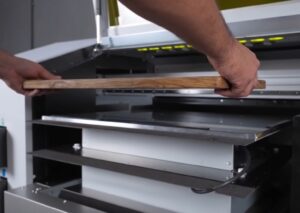
Behind the Scenes: How UV Printing on Wood Actually Works
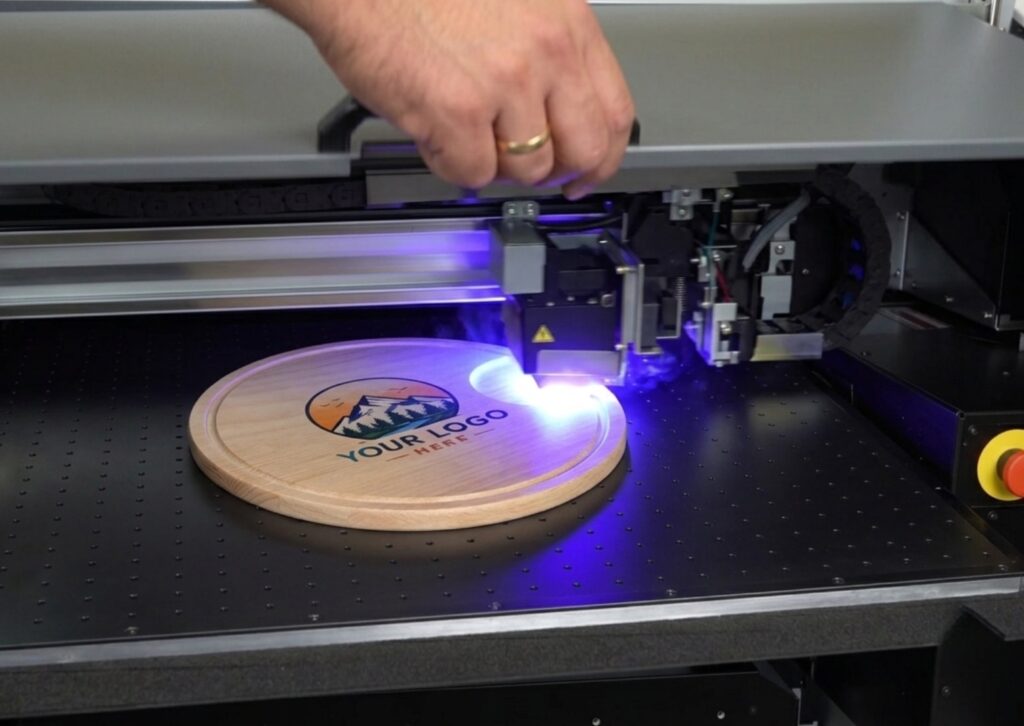
Unlike traditional printing methods that rely on heat or air-drying solvent inks (which penetrate deep into the wood fibers and often blur), UV printing uses a completely different process called photopolymerization.
-
Precision Micro-Droplets: The printer head applies specialized liquid inks directly onto the smooth wooden surface.
-
Instant UV Curing: Immediately following the ink jet, a powerful Ultraviolet (UV) light passes over the surface.
-
The Solid Transformation: The UV light instantly triggers a chemical reaction, causing the liquid ink to turn into a tough, solid film that bonds perfectly with the wood grain.
Because the ink dries in milliseconds, it has no time to bleed or absorb into the wood. The result? Razor-sharp details, accurate corporate colors, and a beautiful tactile finish.
Wood Types: Versatility Meets Professional Recommendations
One of the greatest advantages of UV printing is its versatility across various wood species. Whether the wood is light, dark, fine-grained, or rustic, the technology adapts beautifully to different surfaces.
While we can apply this method to many types of timber, at DB we strictly select and recommend high-quality European wood for our products. For the best branding and longevity results, we primarily recommend:
-
Beechwood (Buk): Known for its solid density, fine grain, and uniform light tone, it provides an exceptionally smooth canvas for sharp, high-contrast logos.
-
Oak (Dąb): Highly durable and prestigious, its distinct, rich grain pattern adds a premium, high-end retail look to any custom product.
The Big Question: Is UV Printed Wood Safe for Serving Food?
Since DB specializes in producing and customising high-quality wooden serving boards, platters, and custom trays, this is the number one question we receive from restaurateurs and corporate clients alike.
Yes, UV printed wooden boards are perfectly safe for serving food—provided they are used for their intended purpose.
The Science of Safety
Liquid inks can contain volatile organic compounds (VOCs). However, once exposed to the UV light during production, the ink undergoes complete curing. The polymers cross-link fully, turning into an inert, non-toxic, and rock-solid plastic film. There are no remaining chemicals to leach out, making it safe to display and serve dry appetizers like cheeses, meats, crackers, nuts, or fruits.

Serving Boards vs. Chopping Boards: A Vital Distinction
While UV printing is flawless for presentation, it is important to understand the technical boundary between serving food and preparing it:
-
Perfect for Serving Boards & Trays: It is the ideal method to add branding to promotional boards meant for food presentation, catering, or corporate gift sets.
-
Not for Active Cutting Surfaces: We strongly advise against placing UV graphics directly on the cutting surface of typical, heavy-duty chopping boards. Heavy, repetitive slicing with sharp kitchen knives can score the wood and damage the printed artwork over time.
Durability & Longevity: Will the Logo Scratch Off?
UV ink does not just sit loosely on top of the wood; it forms a highly resilient structural bond.
-
Water and Moisture Resistance: The cured ink is completely waterproof. It will not run, smudge, or fade when exposed to moisture from food or liquid spills.
-
Scratch Resistance: The hardened polymer surface resists everyday wear and tear from serving utensils remarkably well.
-
Care Instructions: To preserve both the natural wood and the printed logo for years, these products should never be placed in a dishwasher. A gentle hand wash with warm water and mild soap is all it takes to maintain the vibrant branding.
Technical Requirements: Getting the Artwork Ready for Production
To achieve that flawless, high-end retail look on your corporate serving boards, your design team needs to follow a few straightforward technical specifications:
| Technical Parameter | Requirement for Best Results |
| Minimum Resolution | 300 DPI (Dots Per Inch) at 1:1 scale for raster images. |
| Preferred File Format | Vector files (.AI, .EPS, or editable .PDF) for flawless, infinitely scalable edges. |
| Color Profile | CMYK (Standard print profile. Pantone colors will be converted to their closest CMYK match). |
| The White Underlay Option | Optional. We can print a solid white ink layer under your logo to make colors pop accurately. Alternatively, we can print without it, allowing the natural wood grain to show through the colors for an organic, rustic effect. |